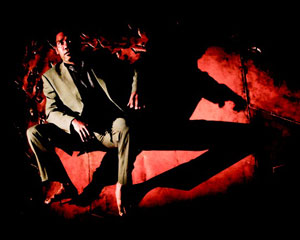
 Left – Trevor Jamieson. Photo – Heidrun Lohr
The Butterfly Effect is often used to describe the confluence of seemingly unrelated and remote causes to social, political or psychological effects that are otherwise beyond comprehension. On seeing Ngapartji Ngapartji tonight, my first thought is whether writer Scott Rankin was aiming to use Maralinga and its aftermath as irrefutable evidence of the Butterfly Effect beyond the realm of physics.
In this epic work, Trevor Jamieson tells the story of the Maralinga nuclear weapons tests from the perspective of the Anangu people of the Western Desert. Through narration, song, mime and film, Jamieson and the rest of the cast pull together loose threads of culture, language and political history into a compelling piece of theatre, but what is truly remarkable is how, from the Anangu perspective, the confluence of events in the development of the Cold War, technological advances by pacifists, and especially the Anangu people's particular cultural and practical customs led to the tragedy of Maralinga.
Of course the story of the Maralinga tests is invariably political, but while Ngapartji Ngapartji addresses the political context, this story is about the people whose way of life, culture and heritage was irrevocably changed by events so extraordinarily remote from the centre of their world.
Trevor Jamieson warmly invites the audience to experience the story from the Anangu perspective. He warms up by engaging in a bit of light-hearted interaction with the audience. It was wonderful to see what seemed to be mostly a very conservative Canberra audience all up on their feet singing 'Heads, Shoulders, Knees and Toes' in Pitjanjatjara, and the use of the language through the performance really grounds the subject matter, which might otherwise have leaned far too much towards the political. The Pitjanjatjara language is almost a character in itself and the simple beauty of its sound is noteworthy. Jamieson's portrayal of multiple characters, often within a single moment, is also noteworthy. The depiction of three waves of British arrivals in the Anangu people's land, first with rifles, then with Bibles, then with nuclear weapons, are increasingly engaging, and of course disturbing. They are depicted, though, with very little antipathy. Though there are some gentle gibes against the invaders, including a reference to the irony of the Cold War (which we usually think of as a conflict without direct military action) leading to the British bombing Pitjanjatjara land, the presentation of this story is not about laying blame; it's solidly focused on the experience of the Anangu and the journey of healing that has only just begun.
What is most valuable about this production is how Jamieson introduces his audience to the Anangu people, his family, as he constantly reminds us, and their customs, culture and traditions, and takes the audience with him, treating us like we are part of the story and helping us to see the events through the lens of the Anangu experience.
Cleverly, or rather, skilfully, writer Scott Rankin has kept the focus on the people involved in Maralinga, providing political context while focusing attention on the people. It is admirable how Rankin has deftly included the political element without allowing it to overtake the story. The experience of the Japanese at Hiroshima and the subsequent Western obsession with America's "toy that melts faces" is political perhaps, but in this context, it is not about the business of politics. Descriptions of a radioactive dust cloud making its way from Maralinga to Adelaide at the time of Tony's Blair's childhood residency there, as well as his mother's death from thyroid cancer, known to be an effect of radiation poisoning, really drives this home as a deeply human story, and only superficially a political one.
The way this story is told is grounded beautifully in the understanding Jamieson presents of his family, the Anangu, and the land they have cared for and have been nourished by for sixty million years. The reference, near the end, to the twenty-five thousand year wait for the land to recover from radioactivity, is put firmly into the context of this sixty million year history. We will wait. The people will heal. The land will heal. Even a nuclear weapon won't wipe out sixty million years of Anangu culture. This is adept and beautifully-balanced theatre. As an Anglo-Celtic Australian, the feeling Jamieson leaves me with, despite the fact that I share my race with the perpetrators of this atrocity, is one of pride to share my nationality with the Anangu. I can only hope some of their courage, honour, love and respect rub off on me and my family.
A Big hART Production
Ngapartji Ngapartji
Writer/Director Scott Rankin
Venue: The Playhouse | Canberra Theatre Centre
Dates: 25 – 28 Jul 2012
Tickets: $53 – $30
Bookings: www.canberratheatrecentre.com.au
Canberra Reviews
Ngapartji Ngapartji | Big hART
- Details
- Trevar Alan Chilver
Most read Canberra reviews
The Jungle and the Sea | Belvoir St Theatre
The Jungle and the Sea is one of the best pieces of theatre I have ever seen.
Diamond | Liz Lea
There are artists who make work, and there are artists who build communities. Liz Lea has spent more than three decades doing both.
Heathers the Musical
The cast is exceptional. The choreography is precise and beautifully executed. The lighting is gorgeous. The whole thing moves with extraordinary confidence and energy.
Mettle | Quantum Leap Australia
I left completely captivated. And actually shaking from the joy of the experience – for me that’s a sure sign of something great.
MOUNTAIN | Melanie Lane
MOUNTAIN is at its strongest in transformation: body into landscape, clothing into architecture, acoustic into electronic, individual into collective.